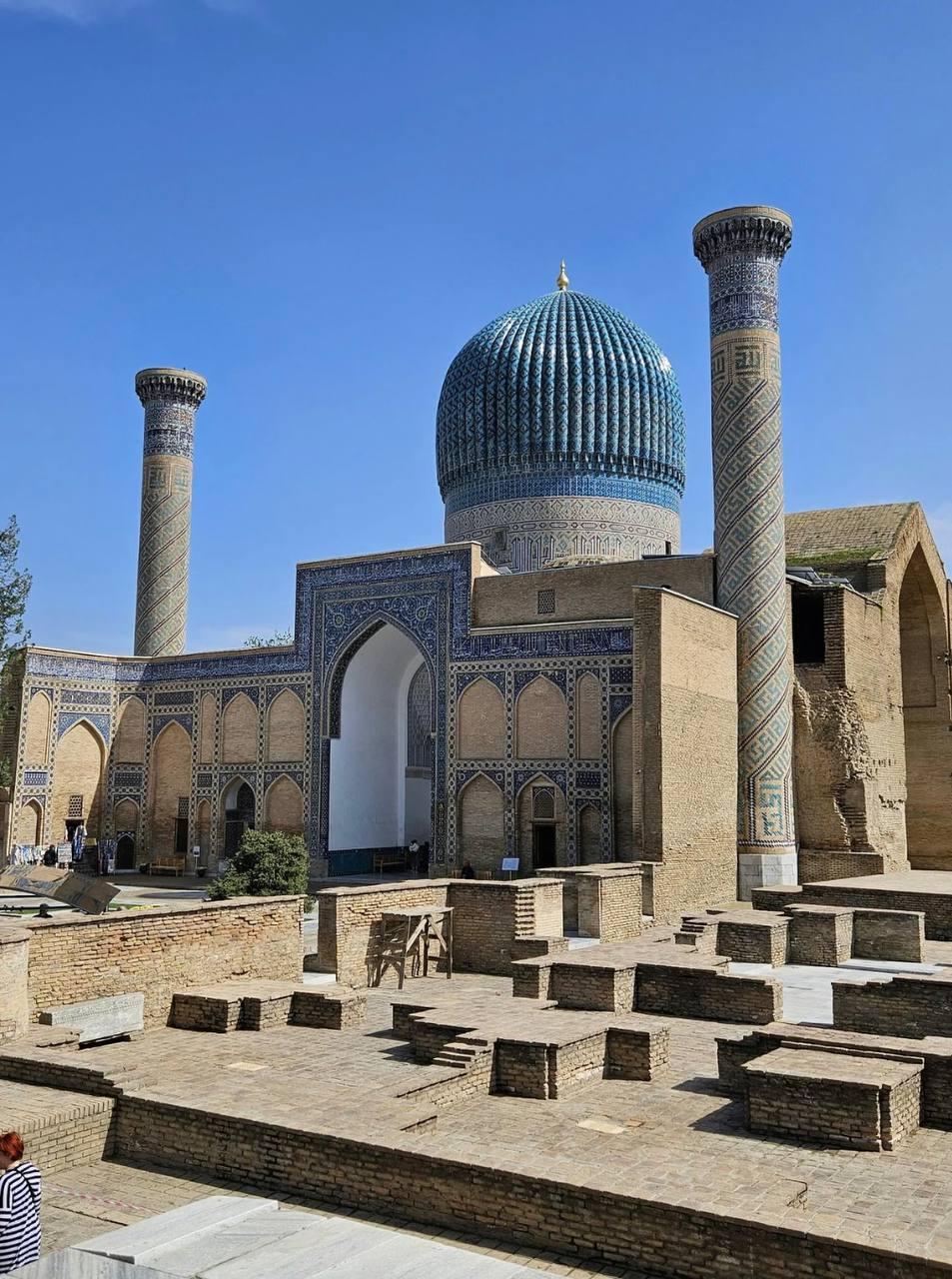
"Gur-e-Amir" translates as "Tomb of the King" — and it is one of the most famous tombs in human history. The mausoleum was built by Timur and, for a long time, served as a model others sought to emulate, securing its place as a landmark in the history of Islamic architecture worldwide. It is widely believed that Gur-e-Amir served as the prototype for both the Taj Mahal and Humayun's Tomb.
The mausoleum was originally intended for Muhammad Sultan — Timur's beloved grandson, who died in 1403 at the age of 27. But fate had other plans: not long after, the great conqueror himself found his final resting place there. The mausoleum also holds the remains of Timur's sons, his grandsons Ulugbek and Muhammad Sultan, and his teacher and mentor, Mir Said Baraka.
A dark legend surrounds the mausoleum: in 1941, Soviet archaeologists opened Timur's tomb — and the very next day, Germany invaded the USSR. Whether this is coincidence or something more is left for each visitor to decide. Atop the building rises a 15-metre, helmet-shaped dome covered in turquoise tilework, visible from a great distance.