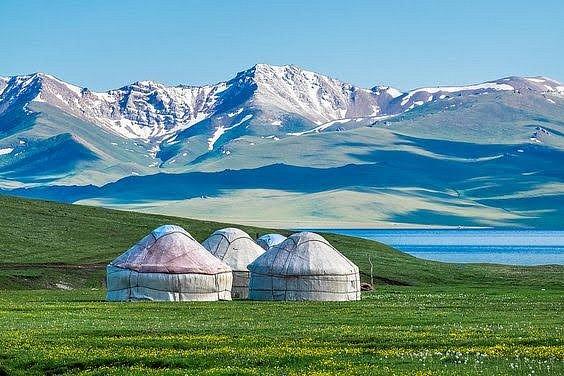
Some places are not simply beautiful — they change something inside you. Son-Kul is exactly that kind of place. This high-altitude lake lies in a vast basin between mountain ranges at 3,016 metres above sea level, and when you finally crest the pass and see it for the first time — immense, azure, seemingly endless — words simply run out. The name "Son-Kul" translates as "lake of wild ducks," though another interpretation has taken hold over the years: "the last lake." It covers 278 square kilometres, making it the largest freshwater body in Kyrgyzstan.
Son-Kul lives by its own calendar. From late September through May the lake is locked in ice, winter temperatures plunge to -20°C and below, and every road becomes impassable. But in summer the basin transforms: the meadows become pastures, and shepherds from surrounding districts bring their horses, sheep and camels here, living with their families in yurts throughout the warm months. This is no tourist performance — it is a genuine nomadic way of life that has continued here without interruption for centuries.
Petroglyphs carved by Bronze Age nomads have been found in the surrounding area, proof that these pastures were prized long before our time. The nights here are dark and cold, and the sky is staggeringly full of stars. A yurt, a hearth, kumiss and silence three thousand metres above the noise of everyday life — that is what people come to Son-Kul for.