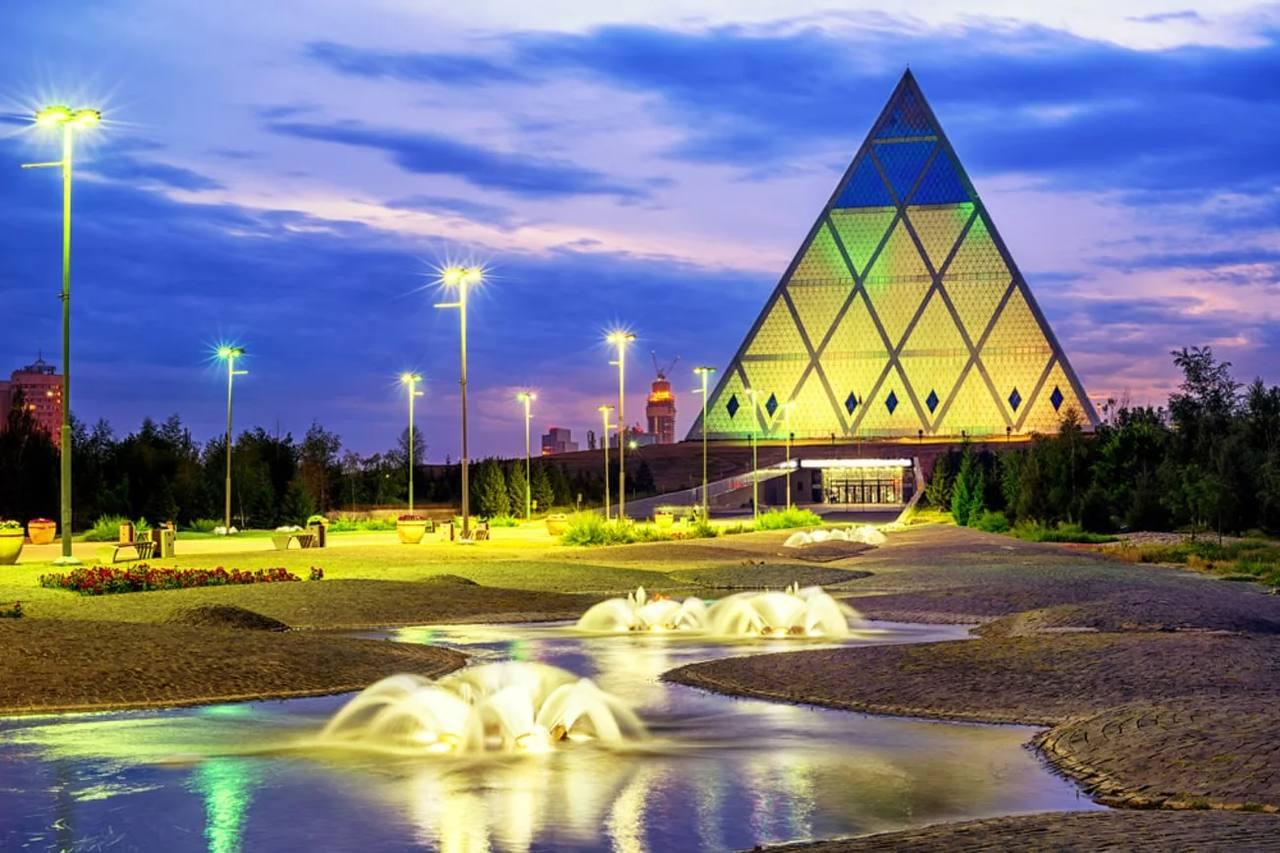
A pyramid rising out of the Kazakh steppe — it sounds unexpected, yet that's exactly what one of Astana's most distinctive landmarks looks like. The Palace of Peace and Reconciliation was designed by British architect Norman Foster specifically to host the Congress of Leaders of World and Traditional Religions. The building went up in just 13 months — a remarkable pace for a structure of this scale.
The base of the building is a square, with each side equal to the pyramid's height of 61.8 metres. The proportions follow the golden ratio of the Fibonacci sequence. Each level carries its own symbolic meaning: the dark lower floor represents the underworld, the white middle section symbolises peace, and the glass dome at the top represents the heavens. Because of the region's extreme temperature swings, the pyramid rests on sliding supports — the walls are designed to shift by up to 6 centimetres.
Inside are an opera hall seating 1,302, conference rooms, exhibition spaces and a permanent display of the national costumes of Kazakhstan's many peoples. The upper part of the pyramid is decorated with a hundred doves — a symbol of unity among the country's ethnic groups.