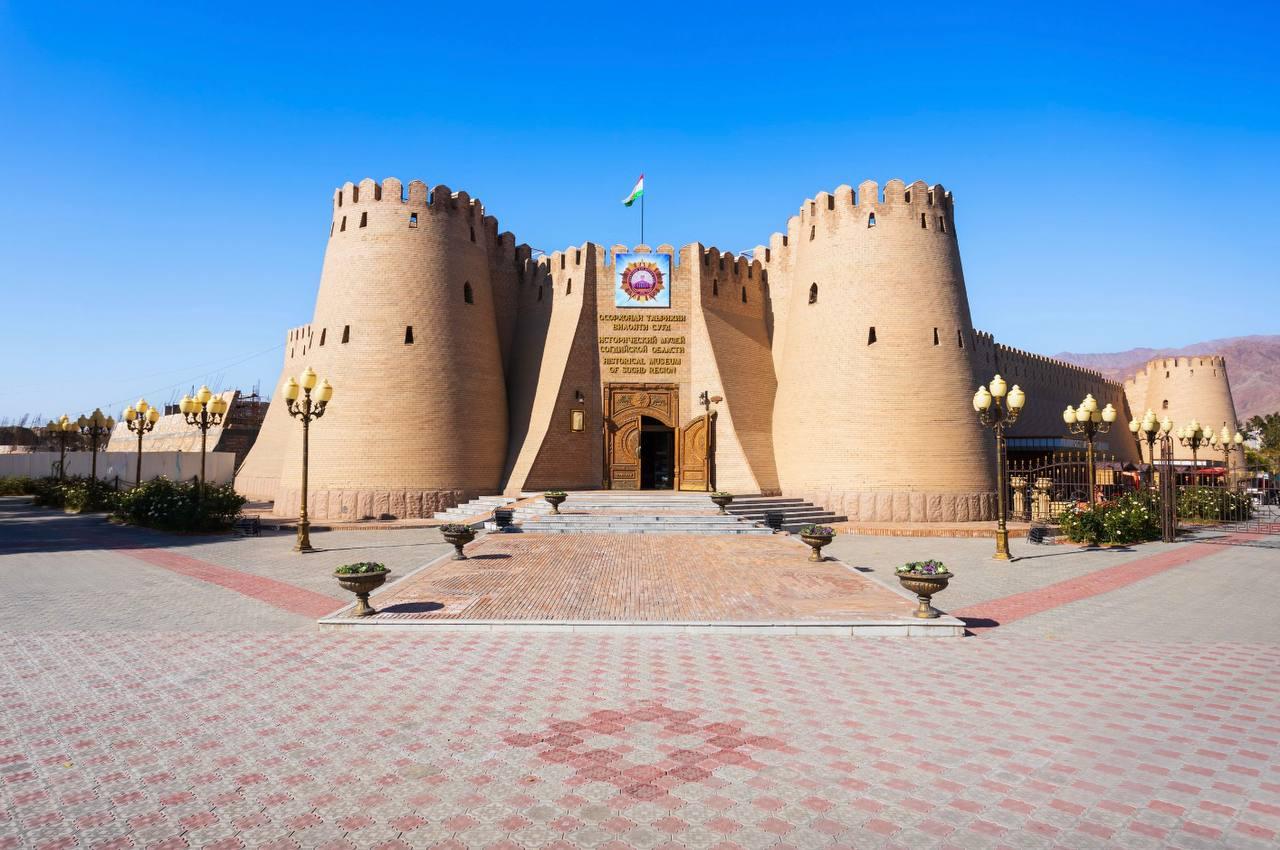
When Genghis Khan's forces arrived at these walls, the siege required an army of 25,000 men and 50,000 captives rounded up from across Central Asia — such was the fortress's reputation for being impregnable. The heroic defence of the Khujand fortress was led by Temurmalik, and his resistance against the Mongol invasion became one of the most celebrated chapters in the Tajik people's struggle for liberation.
The fortress was first established as far back as the 6th–5th centuries BCE, initially as an earthen rampart and later rebuilt as a powerful wall of mud brick. The city and the citadel each had their own separate fortress walls, surrounded by a wide moat filled with water, and medieval Khujand was considered one of the most heavily fortified cities in all of Central Asia.
The structure standing today is a modern reconstruction. The project was designed by Tajik architect Mansur Eshonov, drawing inspiration from the work of Ahmad Lahori — the Persian architect behind the Taj Mahal. Around 4,000 square metres of majolica tiles were produced for the complex's decoration, reviving the almost-lost craft of Khujand's ornamental tilework. Today the fortress houses a museum telling the story of one of Central Asia's oldest cities.