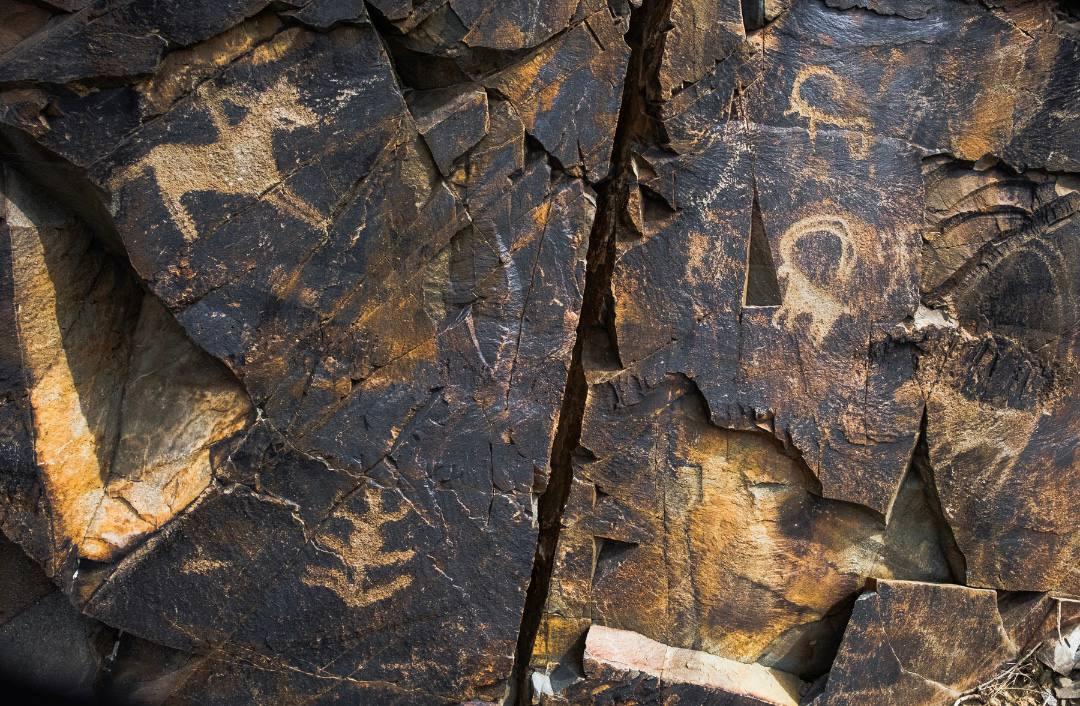
People lived here three thousand years ago. They herded livestock, hunted, worshipped the sun — and left their mark on stone. The Tanbaly petroglyphs were discovered in the late 1950s, and since 2004 the site has been inscribed on the UNESCO World Heritage List.
The monument is located in the Tanbaly valley, in the south-eastern part of the Chu-Ili Mountains, 170 kilometres north-west of Almaty. Most of the carvings date from the Bronze Age, the 14th–13th centuries BCE: wild animals, horses, deer, bulls, anthropomorphic figures and fantastical creatures — an archer in a mask, masked "mummer" figures. The drawings are large, ranging from 25 to 75 centimetres, carved deeply and meticulously into the rock.
In total, more than three thousand images have been recorded here, with a particularly notable series of "sun-headed" figures — thirty of them appear across the site. These are not merely drawings — this is an ancient sanctuary, a place where rituals and prayers were performed thousands of years ago. Standing beside these stones, it's hard not to feel time fold in on itself.