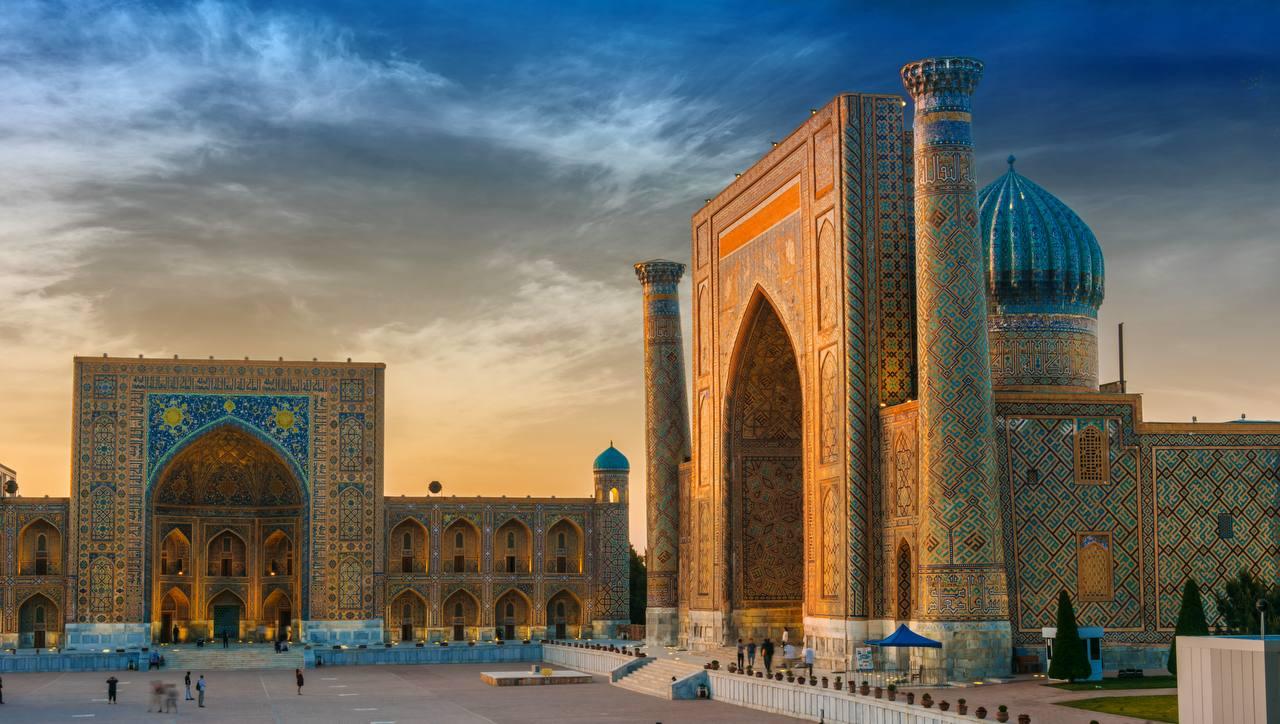
"Registan" comes from Persian, meaning "a place covered in sand" — the term once used across Central Asia for a city's main square. But Samarkand's Registan stopped being just a square long ago. It is the heart of one of the great cities of the Islamic world, a place where architecture speaks louder than words ever could.
The ensemble of three madrasas — Ulugbek (1417–1420), Sher-Dor (1619–1636) and Tilya-Kori (1646–1660) — stands as a unique example of Islamic urban planning and one of the most striking architectural compositions ever built around a city's central square.
The Ulugbek Madrasa, the oldest of the three, was built under Timur's grandson, a remarkable scholar and ruler under whose reign Samarkand became one of the world's leading centres of science and culture. The Sher-Dor Madrasa — "Abode of Lions" — is famous for the mosaic tigers decorating its facade. The Tilya-Kori Madrasa, "covered in gold," astonishes visitors with the gilded dome of the mosque inside.