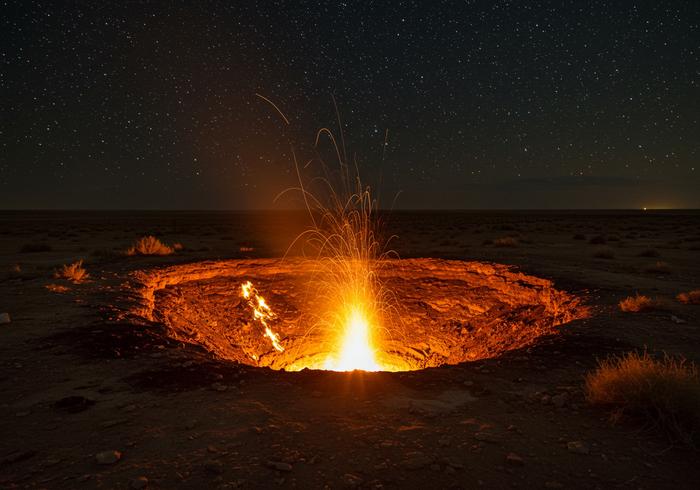
"Darvaza" means "gate" or "door" in Turkic — and the coincidence feels almost mystical. A blazing chasm in the middle of the desolate Karakum Desert does indeed look like an entrance to the underworld. The fire has not gone out for more than half a century.
The crater's story began in 1971, when Soviet geologists were drilling in search of natural gas. The ground beneath the rig collapsed, opening up an enormous pit. To prevent a methane release, the geologists decided to set the gas alight — expecting it to burn out within a few weeks. The fire is still burning today.
The crater measures around 60 metres across and 30 metres deep. Its official name is "The Luminance of the Karakum," but the whole world knows it as the Gates of Hell. At night it lights up the desert for kilometres around, and the heat can be felt from dozens of metres away.
In 2013, Canadian explorer George Kourounis became the first person in history to descend to the bottom of the crater — wearing a heat-resistant suit and collecting soil samples. Temperatures at the bottom reach 1,000 degrees Celsius, yet the samples yielded unique bacteria capable of surviving in such extreme conditions.
Getting here is no easy feat: the crater lies 260 kilometres from Ashgabat, deep in a desert with no roads and no signposts. But that is precisely what makes the encounter unforgettable — a fiery abyss amid endless sands, with not another light on the horizon.